
Autistic or bratty 8 year old? Sometimes it's both
The Ableism in the Comments Section: Volume 2

Do I not deserve support because I’m not autistic enough?
There’s a horrible limbo to being the type of autistic that is generally low support needs and less visible to others. That’s not to say it’s any harder than what medium or high support needs autistic or more visibly autistic people experience, just a different form of difficult.
On the one hand, you navigate life in such a way that people assume evel of general competence (rather than assumed incompetence due to ableism.) Because of this, when you visibly struggle or vocalise the struggles you have, there’s an assumption you aren’t working hard enough to be normal, that have the ability to fix it by ‘just trying harder’, that receiving support from your partner is somehow detrimental to your relationship and must be purposefully malicious in some way.
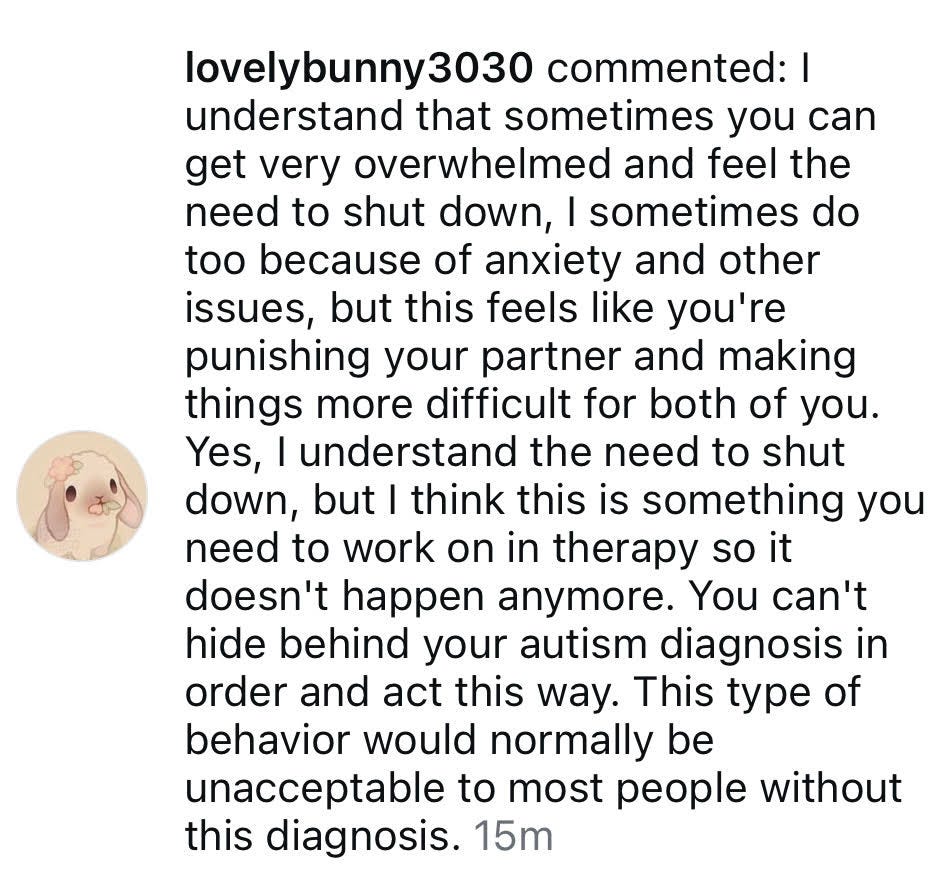
The so-called ‘unacceptable’ behaviour can be seen here.
On the other hand, despite how hard you do actually try to ‘fix’ yourself, always be regulated and avoid shutdowns, you don’t actually have the ability to avoid the shutdowns and dysregulation all the time. You still continue to struggle and require support from your partner which, when seen or shared, goes on to be perceived as…


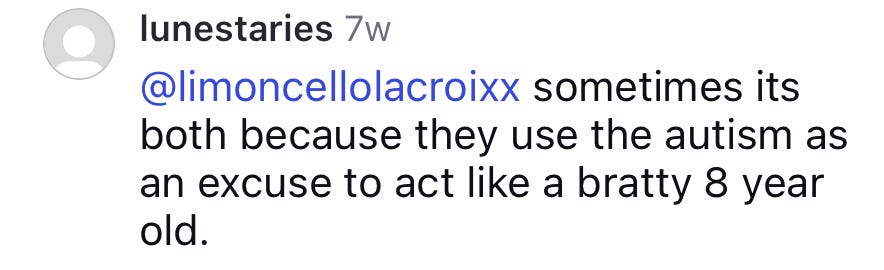
Is it because I have low support needs or am not as visibly autistic?
I can’t help but wonder how these people would react to autistic care and support if I was more visibly autistic.
Would they still comment negatively, because they simply hate disabled people?
Would the comments be worse - the more disabled you are the more putrid the hated?
Or would they pass the post and not comment because, of course, someone who is obviously disabled is assumed to need support and care and therefore doesn’t challenge their world view?
While I don’t know the answer for sure, I suspect all of it is true depending on the viewer. Comments could be, and are, so much worse for some autistic people receiving care and support, especially from a partner, because it’s not expected by societal norms.
At the same time, I expect that, to an extent, the fact my autism is mostly invisible erases and diminishes my struggles, even when I so obviously present them.
Erasure is ableism
The result of sharing my struggles and their distillation into being ‘bratty’ or child-like is erasure from people who have little empathy or willingness to learn about experiences outside of their own.
The infantilisation of my shutdowns reduces my relationship from an ever evolving, mutual act of care and responsibility to that of parent and child. Rather than accept that adults can, and do, struggle and deserve support for those struggles from caring partners, the reaction is hostile.
This is capitalism at play. The capitalism that wants us buying our way out of loneliness and struggle through goods and services, rather than relying on our communities. The capitalism that wants us living in misery, joy stolen, until we buy crumbs of it back.
To be seen as child-like is an insult to those who play capitalism’s game.
These people, the commenters and many of the general public, want to be seen as capitalism's definition of mature, which is unyieldingly competent, tirelessly responsible, masterfully in control and above all use, enduringly independent, no matter the situation.
To be seen as child-like is to be imperfect, flawed, messy, dependent. In adulthood, maturity demands perfection from us and so that’s what we strive for, despite the impossibility of it. That ridiculous standard sucks the joy out of our lives and the miserable get angry at those who shirk perfectionism in favour of something else.
Children experience a wonder and joy adults have long forgotten. They accept care and support, from all manner of adults outside their parents, because they innately know they can not survive alone.
Adults are no different, but capitalism has tricked us into thinking otherwise. They’ve forgotten that to be a perfect human is to be in community. We weren’t built for independence. No one is supposed to be everything to themselves.

Volume 1 explore the intersection if disability and sexism and the role revarsal of care between a man and woman.
Thank you for sharing your story. You are a very brave person! Your partner is an incredible example of pure responsibility. And the story of your relationship with him is a wonderful example of what relationships really are — not easy and requiring constant cooperation, honesty, effort, and attention from all sides.